
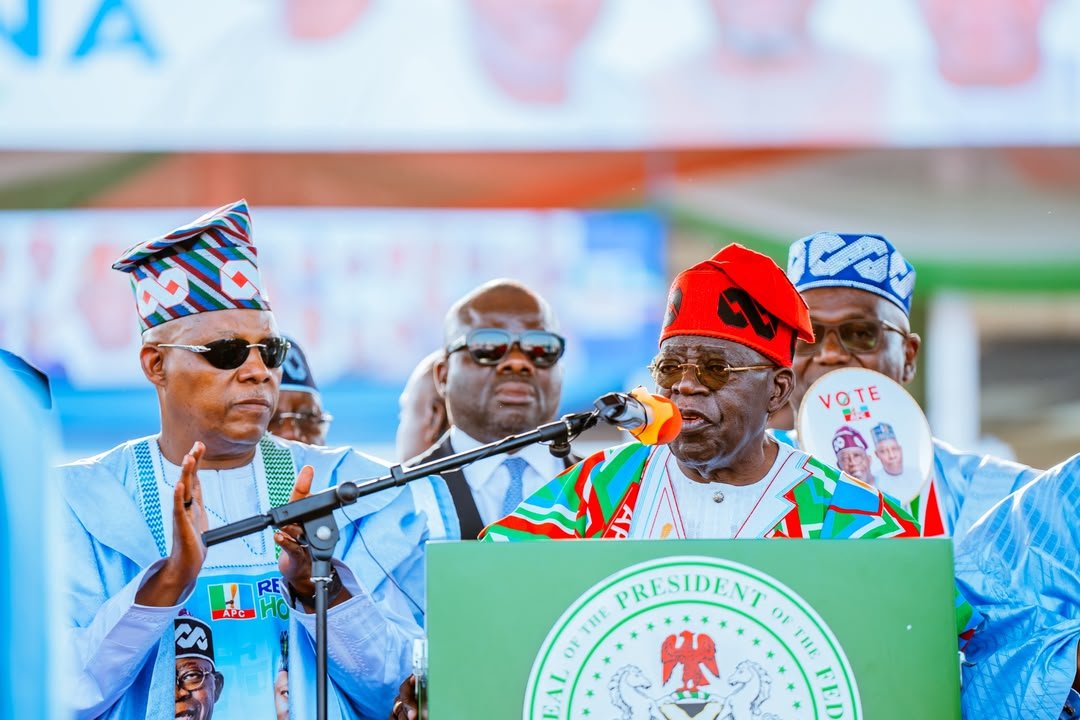
President Bola Tinubu has declared that fuel subsidy belongs permanently to Nigeria’s past and that the associated problems of corruption and smuggling have ended, as he formally launched the All Progressives Congress campaign for the 2027 presidential election in Kaduna on Saturday, 24 October 2026.
Speaking at the Kaduna Township Stadium (also known as Ranchers Bees Stadium), Mr Tinubu told supporters: “What is past is in the past. Fuel subsidy is in our past: no more corruption, no more falsification of invoices, no more lies, no more smuggling of fuel.” He urged the crowd to be wary of opposition promises, particularly pledges by some politicians to restore the subsidy.
The President also blamed previous administrations and the opposition for creating hunger and poverty. He said his government was working to eradicate both problems, that salaries were being paid regularly, and that he was proud of the development efforts of APC governors. He promised “a better tomorrow” and prosperity if given a second term, adding that “our party [is] leading.”
Subsidy removal and its effects
Mr Tinubu removed the petrol subsidy on the day of his inauguration in May 2023. Pump prices subsequently rose from approximately ₦185 per litre to between ₦1,100 and ₦1,400 in many parts of the country. Government officials have stated that the policy and related foreign exchange reforms generated an estimated ₦15.8 trillion in additional resources for the federation over 30 months.
However, the same period has seen a sharp rise in the cost of living. World Bank and IMF assessments place the proportion of Nigerians living below the national poverty line at around 63 per cent in 2025 and 2026, equivalent to roughly 139 to 140 million people. Food inflation and transport costs remain elevated for many households, even as some macroeconomic indicators have stabilised. The government maintains that the reforms were necessary to avert worse outcomes and that social measures and infrastructure investment will eventually improve living standards.
Corruption and smuggling claims
The assertion that corruption and fuel smuggling have ended is not supported by independent measures. Nigeria’s score on the Transparency International Corruption Perceptions Index remains 26 out of 100, with a ranking of approximately 140th to 142nd out of 180 countries in the most recent reports. A 2025 transparency and integrity assessment found that only six of 517 federal ministries, departments and agencies met minimum standards of accountability. While the removal of the subsidy reduced the incentive for large scale fuel smuggling that previously accompanied the old pricing regime, claims of a complete end to the practice have not been independently verified.
Kaduna projects
In Kaduna State, the Tinubu administration and the state government under Governor Uba Sani have pointed to several concrete interventions. These include the reconstruction of the long abandoned Kaduna to Birnin Gwari road at a cost of approximately ₦178 billion, progress on the Abuja to Kaduna corridor, the introduction of free compressed natural gas mass transit buses that have recorded millions of passenger trips, the commissioning of a 300 bed specialist hospital and skills training facilities, and approval for a metropolitan light rail project. State authorities also report improved security that has allowed many previously closed schools and primary health centres to reopen.
The APC currently controls approximately 31 of Nigeria’s 36 state governorships following a series of defections. Whether this numerical dominance has translated into consistent development strides across all states remains a matter of assessment against local outcomes.
Mr Tinubu’s remarks form part of the formal opening of the APC’s national campaign for the election scheduled for 16 January 2027. Opposition figures have rejected the claim that they created the current hardship and have continued to criticise the impact of the subsidy removal and exchange rate reforms on ordinary Nigerians. The President’s statements place the economic record of the past three years at the centre of the contest for a second term.
By John James


- FBI Operation Blackout Leads to Nine Arrests in Nigeria
- Jet2 aircraft from Venice veers onto grass at Birmingham Airport amid Storm Boelo
- NCDC identifies two additional suspected Ebola cases and 53 primary contacts
- Five men jailed over plot to smuggle nearly half a tonne of cocaine into Eastbourne
- Tinubu Defends Subsidy Removal and Claims End to Corruption at Kaduna APC Rally


