
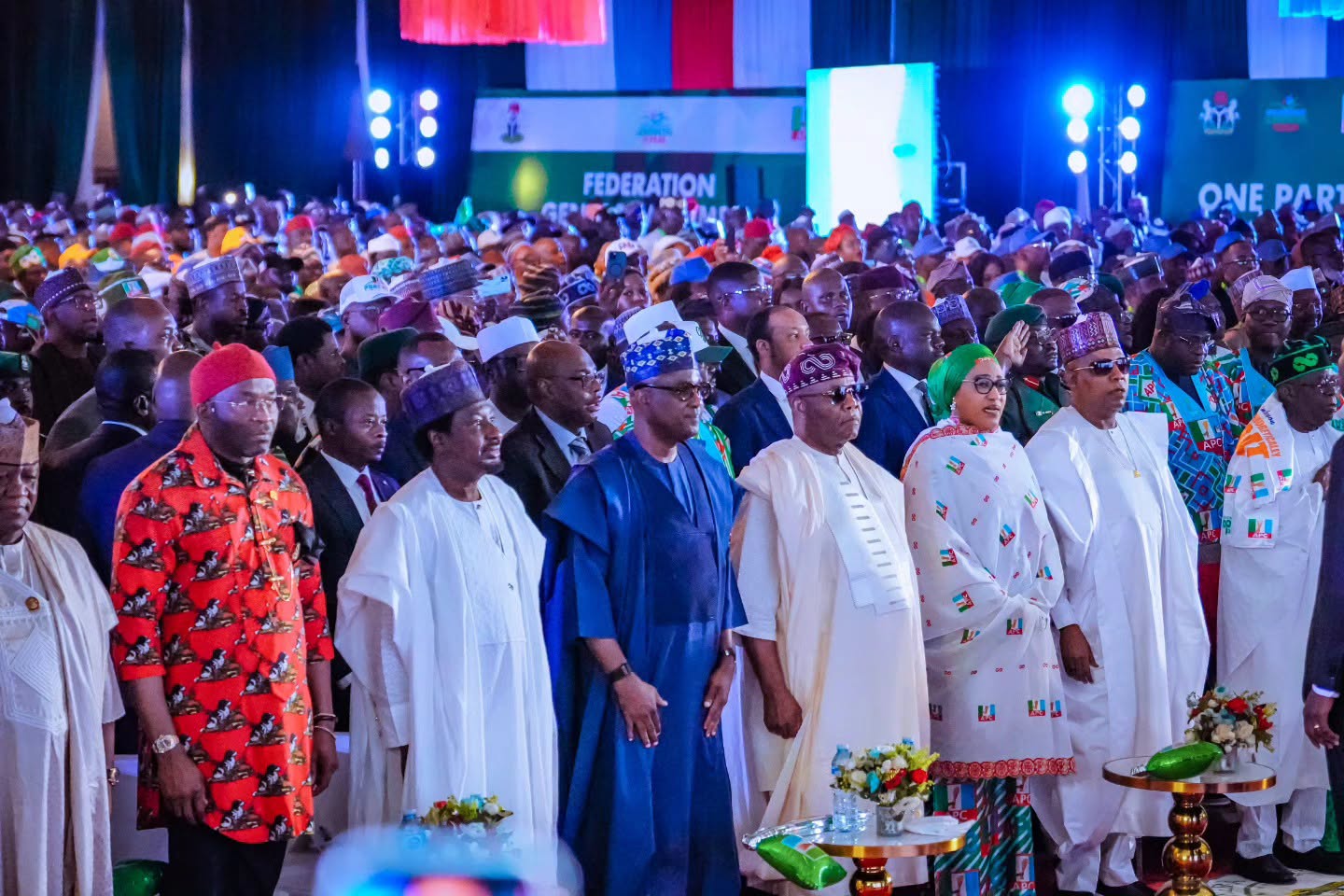
Today in Abuja, at the inauguration of the APC Presidential Campaign Council, a pattern that began with Senator Orji Uzor Kalu hardened into official policy, and was underscored by a revealing slip of the tongue.
Kalu had earlier advised that President Bola Tinubu need not “keep running around campaigning” for 2027. “We are field workers,” he said, “and we are already doing that for him.” Then Governor Hope Uzodimma, Secretary of the Campaign Council, took the stage and asked the President: “Please, Your Excellency, leave the heavy lifting of this campaign to us.” He framed it as a noble choice. Concentrate on governance so that ongoing reforms are not derailed by electioneering.
Tinubu accepted. He told the gathering he was “in full agreement,” that the responsibility of the office does not pause, and that while he would make time to speak to Nigerians, they should “excuse me from going everywhere with you.”
At the same event, the President also referred to himself as “Governor Bola Tinubu.” According to reports of his remarks, he spoke of bringing “Governor Bola Tinubu back for second time.” For a man who has been President of the Federal Republic for more than three years, and who previously served as Governor of Lagos State two decades ago, the slip is not a minor verbal stumble. It makes the long circulating suspicions about his health and cognitive capacity more stark.
On the surface, the decision to stay off the campaign trail is presented as responsible leadership. In reality, it is unprecedented in Nigeria’s democratic history. No sitting Nigerian president seeking re election has ever been openly excused from the physical grind of a national campaign by his own closest allies, with his own ready agreement. Campaigns in this country have always required the candidate to traverse the federation, to be seen, heard, and tested. Even in Cameroon, where Paul Biya has governed for decades in a manner many describe as absentee, the pretence of presence is maintained more carefully than this.
The convenient explanation offered by Tinubu’s inner circle is that governance must take precedence. Nigerians are entitled to ask a simpler question. If the President is not well enough, or sharp enough, to undertake the physical and mental demands of a nationwide campaign, and if he is still slipping into referring to himself as Governor of Lagos, how can he be fit to govern a country of over 200 million people facing insecurity, economic hardship, and complex reforms?
Concerns about the President’s health and capacity have circulated for months. What is new is the open arrangement by which his closest supporters publicly relieve him of the campaign burden, while he himself appears, at times, to be living in an earlier chapter of his political life. As Professor Chidi Odinkalu observed on X, the President has “Nicodemously confesses that he is too unwell to campaign for the support of citizens in #NigeriaDecides2027,” and those meant to be his closest allies applaud. With friends like these, the President should come clean to Nigerians about the true state of his health and wellbeing.
Compare this with older candidates elsewhere. Joe Biden and Donald Trump, both advanced in years, still undertook the physical demands of their campaigns. Fitness for office is not an abstract notion. The ability to campaign is itself a practical test of stamina, presence, and engagement with the people whose votes one seeks.
If Tinubu cannot, or will not, meet that basic test, two consequences follow. First, he owes Nigerians a full and honest account of his health. Second, voters are entitled to conclude that a candidate who cannot campaign, and who still refers to himself as Governor of Lagos, is not a candidate who should be entrusted with another four years of the presidency. The Constitution does not explicitly disqualify a sitting president for inability to campaign, but the people can, and should, do so at the ballot box.
What we are witnessing is not merely a tactical decision to prioritise governance. It is an attempt to normalise the idea that the incumbent need not face the electorate in person, that proxies and structures will suffice, and that questions about capacity can be waved away under the banner of “reforms.” History has not seen this before in Nigeria. Nigerians should not accept it now.
The President must come clean. Or the electorate must decide that a man who will not, or cannot, campaign for their votes is not fit to continue governing them.
By John James


- Tinubu’s Campaign Opt Out: The Governance Excuse That Masks Fitness Concerns Ahead of 2027
- Federal High Court Dismisses Akwa Ibom Suit Challenging EFCC Investigative Powers
- Ghana Repatriates 120 Nigerian Nationals Rescued from Cybercrime Setups
- INEC Clarifies Omission of Candidates from 2027 Governorship List After Supreme Court Ruling
- Nigerians arrested as international operation disrupts Nigerian and West African scam networks


