
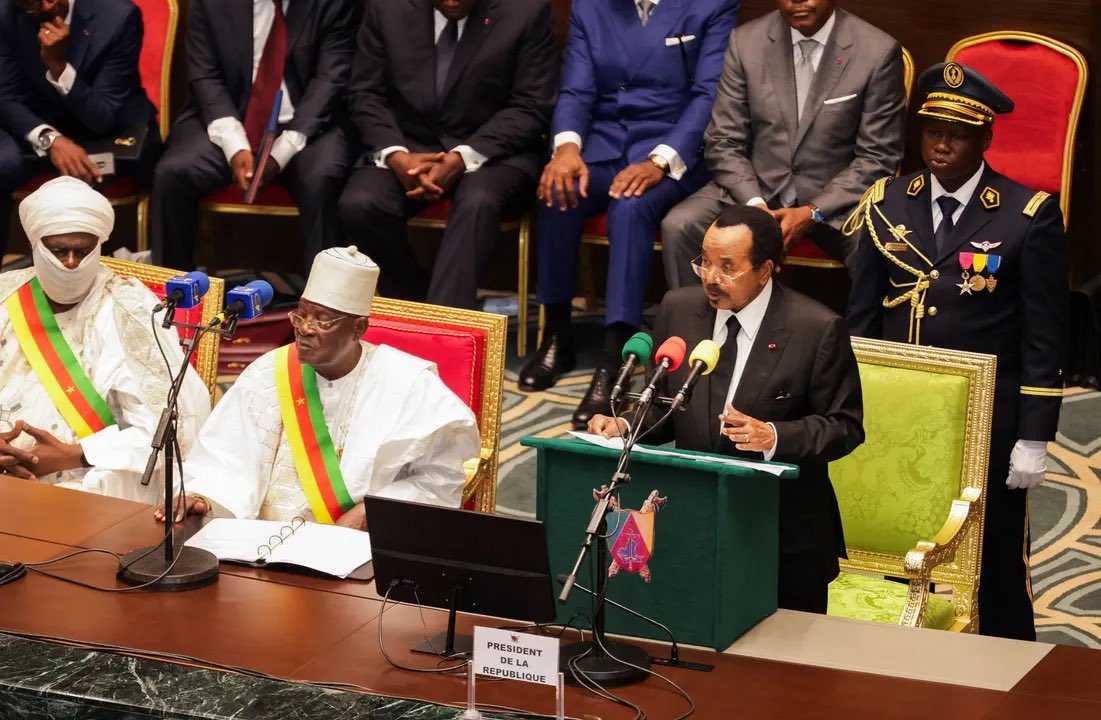
Yaoundé, 28 July 2026 – Cameroon’s President Paul Biya has been out of the country for more than seven weeks, prompting opposition parties to question the continuity of government while the ruling Cameroon People’s Democratic Movement insists the 93-year-old leader remains firmly in control.
Biya, the world’s oldest serving head of state and in power since 1982, left Yaoundé on 7 June with his wife, Chantal Biya, for what the presidency described as a “short private stay in Europe.” He has not been seen in public since and is widely reported to be in Geneva, Switzerland. No official date for his return has been announced, making this his longest absence from Cameroon since taking office.
Opposition figures have grown increasingly vocal. Mamadou Mota, vice-president of the Cameroon Renaissance Movement, described the situation as a “glaring institutional vacuum.” The Social Democratic Front said the country was running on “autopilot,” while other opposition voices have called on the Constitutional Council to examine whether the presidency should be declared vacant. Some lawmakers have urged the government to provide clear information on the president’s status and the effective exercise of power.
The government and ruling party have rejected these claims. Higher Education Minister Jacques Fame Ndongo, a senior ruling-party figure, said Biya continues to follow official business closely and approve documents through his aides, wherever he may be. Communication Minister René Emmanuel Sadi earlier dismissed reports that the president had been admitted to a clinic in Geneva, stating that Biya was in Switzerland but not hospitalised and that his health did not require the level of medical care suggested in some media accounts. Officials maintain that state affairs are being managed normally.
Unconfirmed reports, including from Jeune Afrique, have suggested that Biya received treatment at a private Geneva clinic after falling ill during National Day celebrations on 20 May. Family members are said to have joined him in Switzerland. The presidency has consistently denied any hospitalisation or serious health crisis. Presidential decrees continue to be issued in Biya’s name, including recent approvals of loans and appointments.
The prolonged absence comes against a backdrop of unresolved succession questions. A constitutional amendment earlier this year created the post of vice-president, yet no one has been appointed. Biya’s disputed re-election in October 2025 was followed by protests that were met with a heavy security response. Municipal and legislative elections have been repeatedly postponed, and a long-promised government reshuffle has yet to materialise.
Cameroon already faces an ongoing armed conflict in its English-speaking North-West and South-West regions, where separatist groups seeking independence for “Ambazonia” continue to clash with security forces. Political uncertainty surrounding the presidency has heightened concerns about governance and stability in the wider country, though there is no indication of a broader civil conflict erupting in the French-speaking regions.
As the silence from Geneva continues, the question of where exactly Paul Biya is, and when he will return, remains unanswered.
- No vacancy in Aso Rock: Lagos and Benin monarchs stir 2027 storm
- Which reparations? As Africa leads a global slavery claim, critics say stolen wealth at home must come first
- US lobbyist files $26m defamation suit against Sahara Reporters in Washington
- Ekweremadu still in British jail as late 2028 release date looks more realistic than mid-2027 claims
- The Madness of a Mantra: Nigeria Has Spent Nearly 50 Years Blaming Leadership While Ethnicity Manufactures the Leaders It Gets


