
Sunday 20 September 2026
A cluster of security warnings diplomatic withdrawals and military alerts issued over the past forty eight hours has left governments and travellers assessing a rapidly changing international picture.
The United States travel advisory service TravelGov stated that tensions in the Middle East have left the security environment complex with a real chance of unforeseen escalation. Americans already in the region were told to exercise heightened vigilance and to prepare for possible flight cancellations airspace closures and other travel disruptions. Iranian supported Houthis have carried out attacks on Saudi Arabia including strikes on civilian airports. Officials warned the fighting could widen quickly. Americans not currently in the Middle East were advised to think carefully before travelling to or through the region and to keep a close watch on airline and airport notices. The same advisory noted that United States diplomatic missions have already been targeted both inside and outside the Middle East and that Iran or groups aligned with it may strike other American interests including businesses and sites linked to the United States anywhere in the world.
Reports circulating on Sunday said Iran had placed all its armed forces on Code 100 the highest state of alert covering the Islamic Revolutionary Guard Corps the regular army and internal security units. President Donald Trump left Camp David early and returned to the White House citing the risk of a major escalation. Israeli Prime Minister Benjamin Netanyahu likewise cut short a visit to the United States and flew home the same day. Every American embassy in the Middle East issued its own security alert within a short space of time.
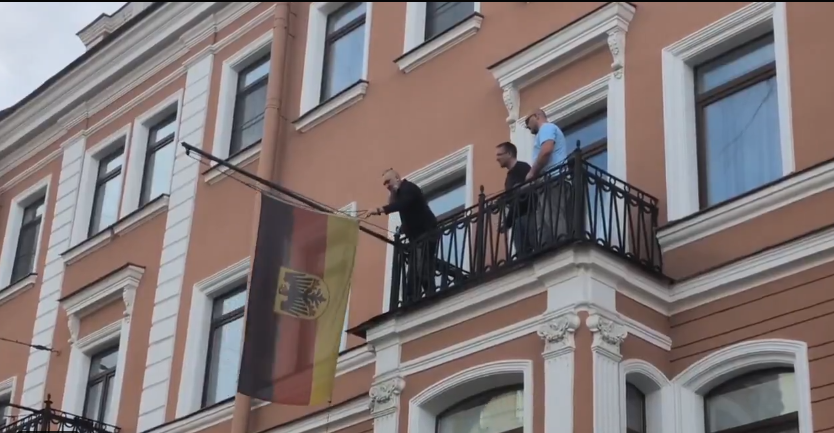
In northern Europe Germany closed its consulate in St Petersburg after more than fifty years of continuous operation. The German flag the European Union flag and the consulate coat of arms were taken down. Staff were ordered to leave Russia by midnight on Monday.
Russian President Vladimir Putin addressed European audiences directly. He said Russia does not want to fight European countries and has no aggressive plans against them. He repeated that Moscow is ready for cooperation and for the restoration of normal relations with its European neighbours.
Separately Saudi Arabia is reported to have asked Syria Turkey Pakistan China the United States Egypt Britain France and Oman for help against the Houthis. The responses so far have been limited. Syria declined to send fighters saying it must first rebuild its own forces. Turkey offered technical assistance under an existing defence arrangement but no troops. Other governments either refused direct military involvement or have yet to commit forces.
In Britain official advice that households should keep stocks of canned food and drinking water has attracted wide attention. A BBC report by special correspondent Allan Little said the government wants the public to prepare for severe disruption to ordinary life and that officials have begun work on an updated national war book last revised decades ago. The guidance is framed as civic resilience rather than an immediate wartime instruction. Air Chief Marshal Sir Richard Knighton Chief of the Defence Staff has described the present period as the most dangerous of his thirty five year career pointing to the war in Ukraine Russian aircraft flying near British airspace cyber operations sabotage and assassination attempts.
Taken together the alerts the consulate closure the Iranian mobilisation and the muted response to Saudi requests have led several commentators to argue that the risk of a wider conflict is higher than many members of the public yet realise.
By A. Ikechukwu


