
Reports of open threats, physical attacks, police interventions and alleged hired thugs targeting opposition figures have intensified across Nigeria, raising serious concerns that the Tinubu administration and its allies are using instruments of the state to constrain rival parties ahead of the 2027 elections. The pattern spans multiple states and involves senior figures in the ruling All Progressives Congress, with critics arguing that such methods undermine the constitutional rights to free movement, association and political participation.
Peter Obi, the leading opposition presidential figure now associated with the Nigeria Democratic Congress, has been a repeated focus. In July 2025, Edo State Governor Monday Okpebholo warned that Obi’s security would not be guaranteed if he entered the state without clearance, following a charitable donation. Labour Party senators and human rights lawyers, including Femi Falana, condemned the remarks as unconstitutional threats to life and freedom of movement under Section 41 of the Constitution. In February 2026, gunmen shot at Obi’s convoy in Benin City while he was travelling to the residence of former Governor John Oyegun, an incident his media team linked to the earlier warnings. In September 2026, thugs chanting for him to go back blocked Obi’s convoy in Benue State as he attempted a humanitarian visit to families affected by killings in Yelwata; the state government denied involvement, though police later arrested dozens connected to the obstruction. Clashes involving alleged politically sponsored thugs and Obi aligned supporters have also been reported in Delta State locations such as Effurun and Warri Airport.
In Edo State, the APC chairman, Jarrett Tenebe, recently declared that anyone standing in the way of delivering 2.5 million votes for President Bola Tinubu would face “AK47 fire.” He made the remarks while the party mobilised support, and he has previously aligned with the governor’s stance on restricting opposition visits. Opposition groups, including the African Democratic Congress, described the language as terrorism rather than politics. In Rivers State, Federal Capital Territory Minister Nyesom Wike warned that it would be difficult for Rotimi Amaechi, the African Democratic Congress vice presidential candidate, to campaign if he continued what Wike called attacks on the President and his supporters. Wike stated that the administration would not allow such conduct even if security agencies and the Independent National Electoral Commission stood aside.
Also read Editorial: Tinubu’s Rhetoric and Silence Cast a Long Shadow Over Nigeria’s Democratic Future
In Enugu State, the Nigeria Democratic Congress governorship candidate, Christian Chinyeaka Ohaa, saw his campaign flag off disrupted by suspected political thugs who fired shots and caused injuries. One person, identified as Nwolle Christopher, was feared dead or seriously wounded amid conflicting reports, while earlier attacks on party meetings had left multiple members with gunshot wounds. These incidents form part of a wider national pattern in which thugs are widely believed to act at the behest of state governors aligned with the centre.
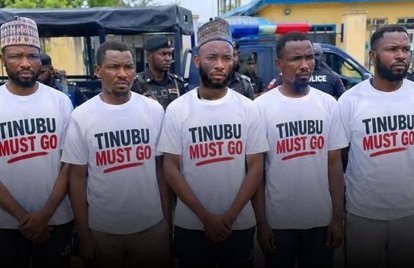
The use of law enforcement agencies has extended to ordinary citizens expressing dissent. In Borno State in late September 2026, police in Maiduguri arrested five men, identified as Baba Aji Gremami, Mustapha Abba Yemen, Abbacha Mohammed Ali, Adam Umar Gubio and Abdulhamid Mohammed, for printing and wearing T shirts bearing the words “Tinubu Must Go.” They were charged with criminal conspiracy, inciting disturbance, disturbance of public peace and thuggery under the Borno State Penal Code, arraigned and remanded. Amnesty International condemned the arrests as arbitrary, insisting that peaceful political expression through clothing is not a crime, and rejected a later police claim that the men were found with drugs as an attempt to justify the detention. A magistrate’s court subsequently granted them bail after applications by their lawyers, including Barrister Alkali Askira. Some accounts alleged the arrests followed a directive from the Borno State government to the Commissioner of Police, underscoring how state authorities and the ruling party have become overt participants in efforts to suppress criticism.
President Tinubu himself told Catholic bishops in July 2026 that “all is fair in politics” and that everyone has equal opportunities, while insisting the Independent National Electoral Commission remains neutral. Critics, including some church leaders and opposition voices, responded that the remark risks being read as licence for any means of securing victory. Separately, Tinubu’s Chief of Staff, Femi Gbajabiamila, was captured on video urging a lawmaker aligned with one faction of the African Democratic Congress to remain inside the party and “scatter them” from within, comments that opposition figures said confirmed efforts to destabilise rivals. Accusations of external interference in opposition structures have also come from figures such as Aminu Tambuwal, while the Independent National Electoral Commission has been accused of delaying registration of new parties and courts have issued rulings affecting the continued recognition of several opposition platforms.
Police actions have drawn further criticism. Amnesty International recently condemned the heavy police blockade of a privately rented venue in Kano for a “Tinubu Must Go” gathering, describing it as part of a troubling pattern of repression against opposition expression. Similar concerns have arisen over the Borno arrests and other restrictions on political activity.
Nigerian politics cannot mature under an approach that treats violence, open threats with firearms language, restrictions on movement and the sowing of internal chaos as acceptable tools of competition. Constitutional guarantees of free association, movement and expression exist precisely to prevent the conversion of state power into partisan muscle. When governors, party chairmen and senior federal officials issue warnings that effectively limit campaigning, when convoys are shot at or blocked, when citizens are arrested for slogans on T shirts, and when police resources are deployed against peaceful gatherings, the space for genuine contest shrinks. The ruling party’s reported efforts to plant division inside rival organisations and to influence registration processes only deepen the risk of one party dominance by default rather than by the ballot.
A democracy grows when parties compete on ideas, records and programmes under rules that apply equally. It stagnates or decays when intimidation and the instruments of the state become substitutes for persuasion. The incidents of recent months, from Edo, Benue, Rivers, Enugu and Delta to Borno and Kano, illustrate a trajectory that, if unchecked, will leave Nigerian politics weaker, more violent and less capable of delivering accountable government. Citizens, institutions and the international community will be watching whether the 2027 contest is conducted under the law or under the shadow of AK47 rhetoric, hired thugs and selective security deployments.
By A.Ikechukwu
- Escalating Threats, Violence and State Power Against Opposition Parties Threaten Nigeria’s Democracy Ahead of 2027
- Editorial: Tinubu’s Rhetoric and Silence Cast a Long Shadow Over Nigeria’s Democratic Future
- US Forces Disable Cargo Vessel Attempting to Breach Iranian Blockade
- Trump Calls for New Ukrainian President After Striking Diesel Deal with Russia
- Israeli President Herzog Calls Captain Smit Machchhar a Hero of Israel, and Pledges Top Civilian Award


