
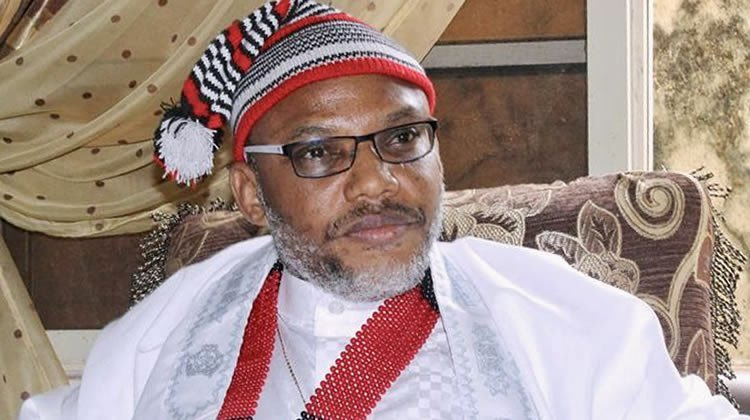
Abuja, Nigeria – 6 November 2025
In a poignant letter dated today, Mazi Nnamdi Kanu, the detained leader of the Indigenous People of Biafra (IPOB), has appealed directly to US President Donald J. Trump for intervention in what he describes as a “hidden genocide” against Judeo-Christians in eastern Nigeria. Writing from his cell at the State Security Services (SSS) headquarters in Abuja, Kanu congratulated Trump on his recent electoral victory and invoked shared Judeo-Christian values to press for urgent action.
Kanu, who has been held since his controversial rendition from Kenya in June 2021, detailed his personal ordeal and broader allegations of state-sponsored violence. He claimed that despite being acquitted of all charges by Nigeria’s Court of Appeal on 13 October 2022 – a ruling he says declared his abduction illegal and unconstitutional – he remains in solitary detention after 1,596 days. “This is state capture of the rule of law to silence a Judeo-Christian voice,” Kanu wrote, labelling his imprisonment “arbitrary, unlawful, and politically motivated” in line with a UN Working Group on Arbitrary Detention opinion from 2022.
The letter paints a grim picture of systematic persecution targeting Christian communities in the region, which Kanu attributes to extremist groups like Boko Haram, ISWAP, and Fulani militias, allegedly operating with state complicity. He accused the Nigerian military of being the “primary perpetrator, shielded by a false narrative that blames victims.” Kanu listed several documented atrocities to support his claims:
- Nkpor Biafra Heroes Day Massacre (30 May 2016): At least 150 peaceful Christian worshippers killed, with bodies reportedly dumped in rivers, according to Amnesty International.
- National High School Aba Massacre (9 February 2016): 22 killed on-site, with 13 bodies exhumed from a borrow pit near Aba-Port Harcourt Road.
- Operation Python Dance II (12-14 September 2017): Over 150 killed in a raid on Kanu’s home in Afaraukwu, described by Amnesty as a “decade of impunity.”
- Obigbo Massacre (October 2020): At least 13 civilians killed, including children, with mass burials and rape reported.
- Port Harcourt (Igweocha) Trump Solidarity Rally (20 January 2017): Supporters gunned down by soldiers under “Islamist-sympathetic command.”
Kanu further alleged that these incidents form part of a broader strategy to “demonise IPOB,” including declaring the group a “terrorist organisation” in 2017 despite zero evidence of violence, and killing over 2,000 Igbo youths in “counter-terrorism” operations between 2021 and 2025. He drew parallels to Rwanda’s pre-genocide playbook, urging Trump to act to prevent a “second Rwanda in Africa.”
In a direct call to action, Kanu respectfully urged the US President to:
- Launch a US-led independent inquiry into state-sponsored massacres of Judeo-Christians in eastern Nigeria, granting full access to mass graves, military logs, and survivor testimonies.
- Convene emergency Congressional hearings on the Igbo Christian genocide, featuring the 13 October 2022 Court of Appeal judgement discharging him, the UN Callamard report on Aba and Nkpor, and Nigeria’s defiance of its own constitution.
- Impose targeted Magnitsky Act sanctions on key figures, including Lt-Gen. Tukur Yusuf Buratai (Ambassador to Benin), current DSS Director-General Yusuf Bichi, and South-East military commanders implicated in Obigbo.
- Support an internationally-supervised referendum on self-determination for the Igbo people, as affirmed by the African Charter on Human and Peoples’ Rights (Article 20), as the “only peaceful path to ending this cycle of violence.”
The letter, delivered through the US Embassy in Abuja, enclosed several documents, including the full text of the Nigerian Court of Appeal judgement, a Federal High Court ruling barring his trial, UN reports, and Amnesty International findings. Kanu closed with a biblical invocation, praying for Trump to be granted “wisdom and courage to deliver His people once again,” referencing the God of Abraham, Isaac, and Jacob.
Kanu’s case has long drawn international scrutiny. IPOB, which seeks the secession of Biafra – a region that briefly declared independence in 1967, leading to a civil war that claimed over a million lives – was proscribed as a terrorist group by the Nigerian government in 2017. Kanu fled Nigeria that year after jumping bail on treason charges but was repatriated from Kenya in 2021 in an operation condemned by human rights groups as an extraordinary rendition. Despite the 2022 acquittal, Nigeria’s Supreme Court overturned the appeal court ruling in December 2023, ordering a continuation of the trial, which remains stalled.
Human rights organisations have echoed concerns about religious persecution in Nigeria, with Christians in the north and east facing attacks from Islamist militants and herder-farmer conflicts. However, the Nigerian government has consistently denied allegations of genocide or state complicity, attributing violence to banditry and insurgency.
As of this writing, there has been no immediate response from the White House or the Nigerian authorities to Kanu’s letter. With Trump set to focus on “America First” policies, it remains unclear whether the US will engage with this African issue. Advocates hope the appeal’s timing, coinciding with Trump’s return to power, could prompt fresh diplomatic pressure on Abuja.


