
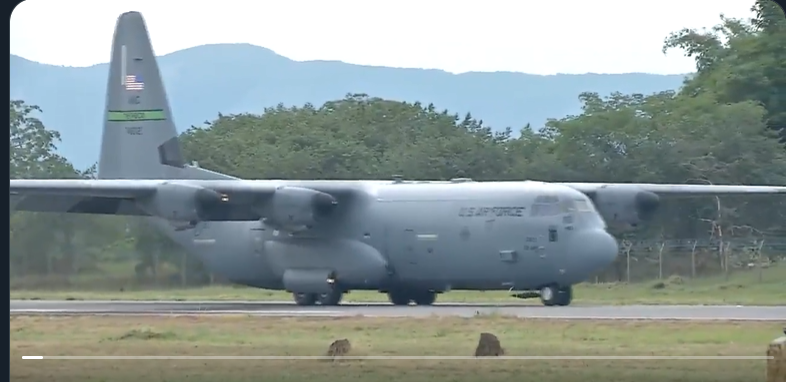
6 November 2025 – The United States military has prepared contingency plans for potential strikes against Nigeria, prompted by President Donald Trump’s directive to address what he describes as the mass slaughter of Christians in the country.
According to a report by The New York Times, the US Africa Command (AFRICOM) has forwarded its options to the Department of War this week, at the behest of Secretary Pete Hegseth. The plans outline three levels of intervention: heavy, medium, and light, each calibrated for varying degrees of escalation.
The “heavy” option represents the most aggressive approach, involving the deployment of an aircraft carrier group to the Gulf of Guinea off Nigeria’s coast. This would enable fighter jets or long-range bombers to target sites deep within northern Nigeria, where Islamist militants are active.
The medium-tier plan focuses on drone strikes against militant camps, bases, convoys, and vehicles. Utilising Predator and Reaper drones, which can loiter for extended periods, the US would leverage intelligence to establish targets’ patterns of life for precise operations.
The lightest option emphasises collaboration with Nigerian forces, with the US providing military and diplomatic support to combat groups like Boko Haram and other insurgents responsible for attacks, abductions, and killings.
The primary objective, as stated by officials, is to target Islamist militants, safeguard Christians from violence, and resolve the protracted insurgency in Nigeria. However, significant concerns have been raised about the feasibility and potential repercussions of these strategies.
President Trump’s recent threats stem from his designation of Nigeria as a Country of Particular Concern (CPC), leading to a suspension of arms sales and technical aid. He has accused the administration of President Bola Tinubu of permitting the “persecution of Christians,” vowing that any US action would be “fast, vicious, and sweet.”
In a statement, Mr Trump declared: “Christianity is facing an existential threat in Nigeria. The United States cannot stand by while such atrocities are happening there, and in numerous other Countries. We stand ready, willing, and able to save our Great Christian Population around the World.”
Despite these assertions, the Nigerian government has firmly rejected the allegations of genocide. Analysts point out that violence in regions like the Sahel and Middle Belt often arises from complex issues, including land disputes, ethnic tensions, and resource conflicts, rather than solely religious persecution.
Groups such as Boko Haram and the Islamic State West Africa Province (ISWAP) have targeted both Muslims and Christians indiscriminately. Notable incidents include the 2017 mosque bombing in Mubi, Adamawa State, which killed at least 50 people, and a 2018 double suicide attack in another Adamawa mosque that claimed 86 lives.
Military experts have warned of the risks. Retired Army General Paul Eaton, a veteran of the Iraq War, described potential US involvement as a “fiasco,” likening it to “pounding a pillow” – an effort that might cause temporary disruption but fail to address underlying causes.
Challenges abound for each option. The heavy plan is hampered by limited US carrier availability; one vessel, the Gerald R. Ford, is being redirected to the southern Caribbean amid Trump’s campaign against drug cartels, while others are committed elsewhere or in maintenance.
Drone operations under the medium plan face logistical hurdles due to the US withdrawal from bases in Niger’s Agadez and Niamey in August, now occupied by Russian forces. Launches would need to originate from distant sites in southern Europe or Djibouti.
The light option is complicated by the dissolution of the United States Agency for International Development (USAID) earlier this year, including the closure of its Abuja office in July, depriving the US of a key partner for on-ground implementation.
As the Department of War reviews these proposals, the international community watches closely, amid fears that unilateral US action could exacerbate regional instability rather than resolve it.
This report is based on information from The New York Times and Premium Times Nigeria.


