
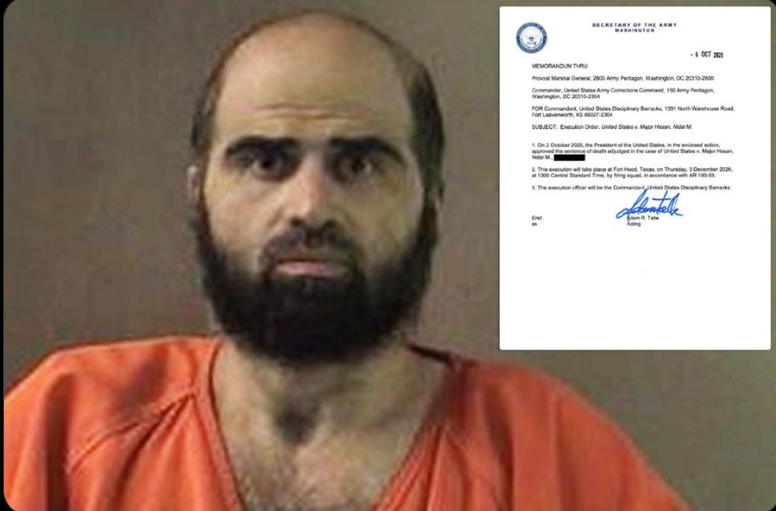
The acting secretary of the US Army has fixed the date and place for the execution of Nidal Malik Hasan, ordering that the former Army major be put to death by firing squad at Fort Hood, Texas, on Thursday, 3 December 2026, at 1 p.m. Central Time.
Acting Secretary Adam R. Telle announced the timetable late on Tuesday, 6 October, in a post on X and in a memorandum of the same date from the Office of the Secretary of the Army. The order, addressed through the Provost Marshal General and the commander of the United States Army Corrections Command to the commandant of the United States Disciplinary Barracks at Fort Leavenworth, states that President Donald Trump approved the sentence of death on 2 October 2026.
“The execution of Nidal Hasan by firing squad will take place at Fort Hood, Texas on Thursday, December 3rd, 2026, at 1 p.m. CT,” Telle wrote. The memorandum says the execution will be carried out in accordance with Army Regulation 190-55, and that the execution officer will be the commandant of the Disciplinary Barracks.
If the sentence is carried out, it will be the first execution by the US armed forces since 1961, when Army Private John Bennett was hanged at Fort Leavenworth, and the first Army firing squad execution since Private Eddie Slovik was shot for desertion in 1945.
The timetable follows an announcement on Monday by Pentagon spokesman Sean Parnell that Defence Secretary Pete Hegseth had recommended death by firing squad and that President Trump had approved it. Parnell described Hasan as “the jihadist who opened fire on unarmed American soldiers at Fort Hood in 2009” and said he had killed 13 people and wounded 32 others while shouting “Allahu Akbar”. Hegseth replied to the statement with a single word: “Justice.”
Parnell said the secretary of the Army would set the time and place. Under Army policy, an execution is to fall no sooner than 60 days and no later than 150 days after presidential approval. The 3 December date sits inside that window. Officials have not said whether further litigation could still intervene.
Hasan, then an Army psychiatrist, opened fire on 5 November 2009 inside the Soldier Readiness Processing Center at Fort Hood, where troops were preparing for deployment. He killed 13 people, 12 soldiers and one civilian, and wounded more than 30 others before he was shot and paralysed by civilian police.
At his 2013 court martial he offered almost no defence, told the panel that the evidence would show he was the shooter, and described himself as a soldier who had “switched sides”. He said the attack was intended to stop soldiers deploying to Afghanistan. A panel of officers convicted him of 13 counts of premeditated murder and 32 counts of attempted premeditated murder and unanimously sentenced him to death. He has since been held on military death row at Fort Leavenworth, Kansas.
The US Supreme Court declined in March 2025 to review the case. Reporting by the Associated Press and others notes that a habeas corpus petition in the civilian federal courts could still delay the execution, potentially for years.
Military death sentences require presidential approval, and executions have been exceptional. Only a handful of service members remain on military death row. A 2019 revision of the relevant Army regulation removed a fixed reference to lethal injection and left the method to be designated through the chain of command. The Pentagon has said the firing squad was Hegseth’s recommendation.
The execution is ordered to take place at the installation where the killings occurred. Fort Hood, in central Texas, has in recent years also been known as Fort Cavazos. Official statements this week have used the name Fort Hood.
Families of the victims were notified of the date by email, according to CBS News. The Army has not published a witness list. Regulation provides for media witnesses to be selected.
Hasan’s lawyers had not, at the time of the Army’s announcement, publicly confirmed whether they would seek a stay. The memorandum records the presidential approval, the date, the place, the method and the execution officer. It does not address outstanding appeals.
By A.Ikechukwu
- Keyamo and Air Chief agree closer civil and military aviation safety collaboration after Igbokoda tragedy
- President Tinubu Mourns Chief Ralph Obioha and Praises His Stand for Democracy
- Fifty nine years on, an Asaba survivor recounts how federal troops killed men who had come out for peace
- Kanu appeal: fresh plea, repealed terrorism Act, and whether sections 97 and 98 can still save the conviction
- Shettima arrives in Addis Ababa for Nigeria–Ethiopia nutrition leadership exchange


