
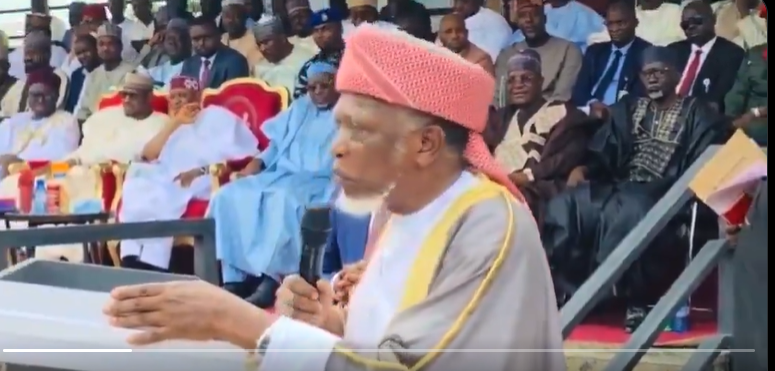
A senior Islamic cleric has once again injected toxic religious majoritarianism into Nigeria’s already fragile political discourse. On 9 August 2026, Sheikh Sani Yahaya Jingir, National Chairman of the Ulama Council of Jama’atu Izalatil Bid’a Wa’Ikamatis Sunnah (JIBWIS), addressed a campaign gathering in Kano tagged “Abba Go Again” in support of Governor Abba Kabir Yusuf. In a speech delivered in Hausa, Jingir openly celebrated a Muslim-Muslim political ticket, dismissed non-Muslims as “infidels,” and urged his audience to obtain permanent voter cards so they could “show the infidels their limit.”
The remarks, captured on video and widely circulated, leave little room for charitable interpretation. Jingir declared: “Special thanks to my (political) hero, Bola Tinubu who raised the flag of this political ideology, describing it as a purely Muslim-Muslim coalition. I am among the staunch advocates of the Muslim-Muslim ticket, and I call on you to come together for Muslim-Muslim ticket. I am aware that the infidels are embittered by this word. However, are there no Christians alike? Are there no Jews? Are there no traditionalists? Have I done anything wrong by merely campaigning for a Muslim-Muslim ticket? Have I stopped the Christians from their own slogans? Have I stopped traditionalists from a similar campaign? But as a Muslim, I repeat it, Muslim-Muslim! No going back on this.”
He continued: “I urge all of us here to go and get our voters’ cards ready. Let’s show the infidels their limit, who claim they are more populous than us in Nigeria. They are lying! If it wasn’t for my stance on a Muslim-Muslim ticket, somebody would have claimed they are more populous than us. But by the grace of Allah, we defeated them so ignominiously that they did not even make it to the second place in the polls, did they? They came third after all. Therefore, my vote is for a Muslim-Muslim candidate! What about you, the Muslim umma?”
This is not political advocacy. It is religious bigotry dressed up as electoral strategy. By labelling fellow Nigerian citizens “infidels” and framing democratic participation as a contest to put non-Muslims in their place, Jingir has crossed a dangerous line. Nigeria is not a theocratic project. It is a multi-religious federation whose Constitution prohibits the adoption of any state religion and guarantees freedom of thought, conscience and religion.
Jingir’s central claim that electoral outcomes somehow prove Muslims are decisively more numerous than Christians is unsupported by evidence. Nigeria has not conducted an official census that records religion since 1963. Subsequent national censuses deliberately avoided the question precisely because of its explosive potential. No credible dataset supports the triumphalist assertion that one faith has “defeated” the other demographically or that non-Muslims are simply “lying.” Treating population estimates as a licence for religious domination is both factually reckless and politically reckless.
History offers a sobering warning. The climate of ethnic and religious suspicion that preceded the January 1966 coup was fed by precisely this kind of polarising rhetoric claims of numerical or civilisational superiority, fears of domination, and the reduction of complex political grievances to religious or ethnic scores. The coup itself, the July counter-coup, the northern pogroms and the eventual civil war demonstrated how quickly such language can escalate into national catastrophe. Jingir’s language of “showing the infidels their limit” belongs to the same poisonous tradition.
Several public figures have already rejected the comments. Femi Fani-Kayode described the rhetoric as “highly provocative” and “extremist,” insisting that Nigeria is a secular, multi-religious state in which Christians and Muslims exist in roughly equal numbers. Former Sports Minister Solomon Dalung warned that reducing politics to a religious headcount and speaking of “infidels” threatens national unity. These rebukes are welcome, but insufficient. Words that frame fellow citizens as enemies to be limited or defeated have consequences.
The Department of State Services (DSS) has a clear duty here. Public advocacy that deploys religious slurs, asserts unproven numerical supremacy, and urges one religious community to put another “in its place” risks constituting hate speech and incitement under Nigerian law. Jingir is not a fringe street preacher; he is a prominent national cleric whose words carry weight among sections of the Muslim population. Allowing such rhetoric to pass without consequence signals that religious majoritarianism is an acceptable form of political speech.
Nigeria’s problems insecurity, economic hardship, institutional failure, will not be solved by Muslim-Muslim tickets, Christian-Christian tickets, or any other confessional arithmetic. They will be solved, if at all, by competent, accountable governance that treats citizens as Nigerians first. Clerics who reduce the country to a religious battlefield do the opposite of leadership. They deepen the very fractures that have repeatedly brought Nigeria to the brink.
Sheikh Sani Yahaya Jingir’s statements in Kano are an affront to the idea of a shared national citizenship. They deserve unambiguous public condemnation and a serious investigation by the security agencies charged with protecting the country’s internal stability. Anything less is an invitation to further division.
- Supreme Court restores Electoral Act rules on party registers and primaries
- Lagos court remands influencer KC Luxury and two others over alleged 184.5kg cocaine haul
- Lagos Police Identify Inspector In Viral Video And Begin Disciplinary Action
- Utomi Restates Support for Obi Presidency and Rejects Any Vice President Role
- Peter Obi rejects Anambra debt claims and says official records contradict the US$123 million figure


