Cambridge
Nigeria’s anti-corruption chief has appealed to whistleblowers around the world to come forward with intelligence on stolen Nigerian assets hidden overseas, offering them between 2.5 and 5 per cent of whatever is recovered.
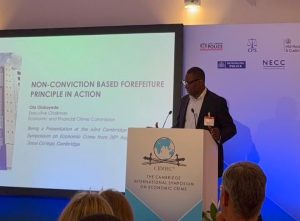
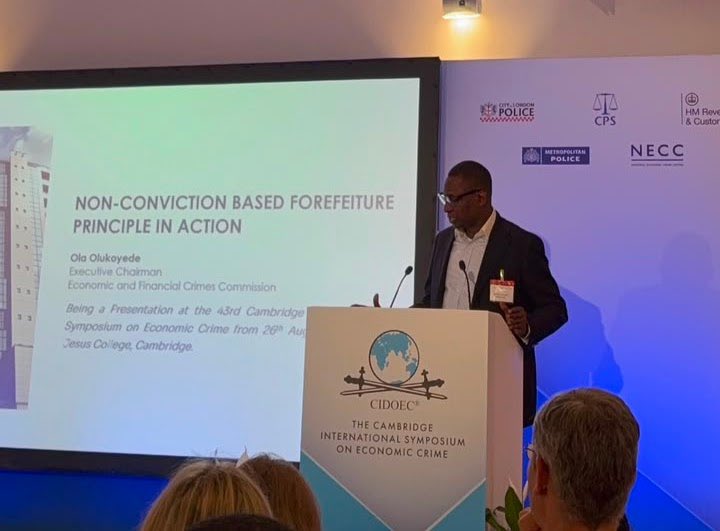
Ola Olukoyede, Executive Chairman of the Economic and Financial Crimes Commission (EFCC), made the appeal on Wednesday while speaking at the 43rd Cambridge International Symposium on Economic Crime at Jesus College, University of Cambridge.
“I welcome all of you to the world of whistleblowing,” he told delegates. “If any one of you is privy to where Nigerian assets are stolen or taken to anywhere in the world, we have an incentive for you; between 2.5 per cent and 5 per cent, it’s going to go back to you upon recovery. That is an incentive we have put in place to encourage people to come forward to give information about stolen assets. You never tell if you give any information here, some of you may leave this place a multi-millionaire in your lifetime.”
The call came on the third day of the week-long symposium, whose theme this year is asset recovery and the rule of law. Olukoyede was speaking in a session on non-conviction-based forfeiture, a legal route that allows the state to seize assets suspected to be the proceeds of crime without first securing a criminal conviction. He compared Nigeria’s framework to systems already in use in Australia and Canada.
He said the EFCC had forfeited cash and assets worth more than half a billion dollars to the Nigerian government in less than three years since he took office. Those recoveries, he argued, were the product of determined investigators, a robust judiciary and usable intelligence.
Through the same non-conviction-based route, he said, the commission had taken an aircraft, a university, estates and houses believed to be proceeds of crime. Among the examples he cited were 752 housing units recovered from Godwin Emefiele, the former Governor of the Central Bank of Nigeria, and an investigation of Abubakar Malami, SAN, the former Attorney-General of the Federation and Minister of Justice.
“Sometime last year, I opened investigations upon reasonable suspicion of criminal abuse of office by the immediate past attorney-general of Nigeria,” Olukoyede said. “We discovered that within eight years of his being in office, we were able to trace about 57 such properties to him. We’ve been able to forfeit about 48.”
The symposium, now in its 43rd year and held under the auspices of the University of Cambridge’s Centre for Geopolitics, draws judges, prosecutors, financial intelligence officials, regulators and academics from more than 80 countries. It runs from 23 to 30 August.
Olukoyede’s pitch was aimed as much at the room in Cambridge as at anyone abroad who may know where Nigerian public money or property has been parked. The reward, he stressed, is paid only after recovery and only if the information is useful.
By Chris Ikefe