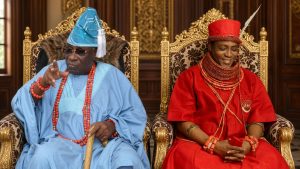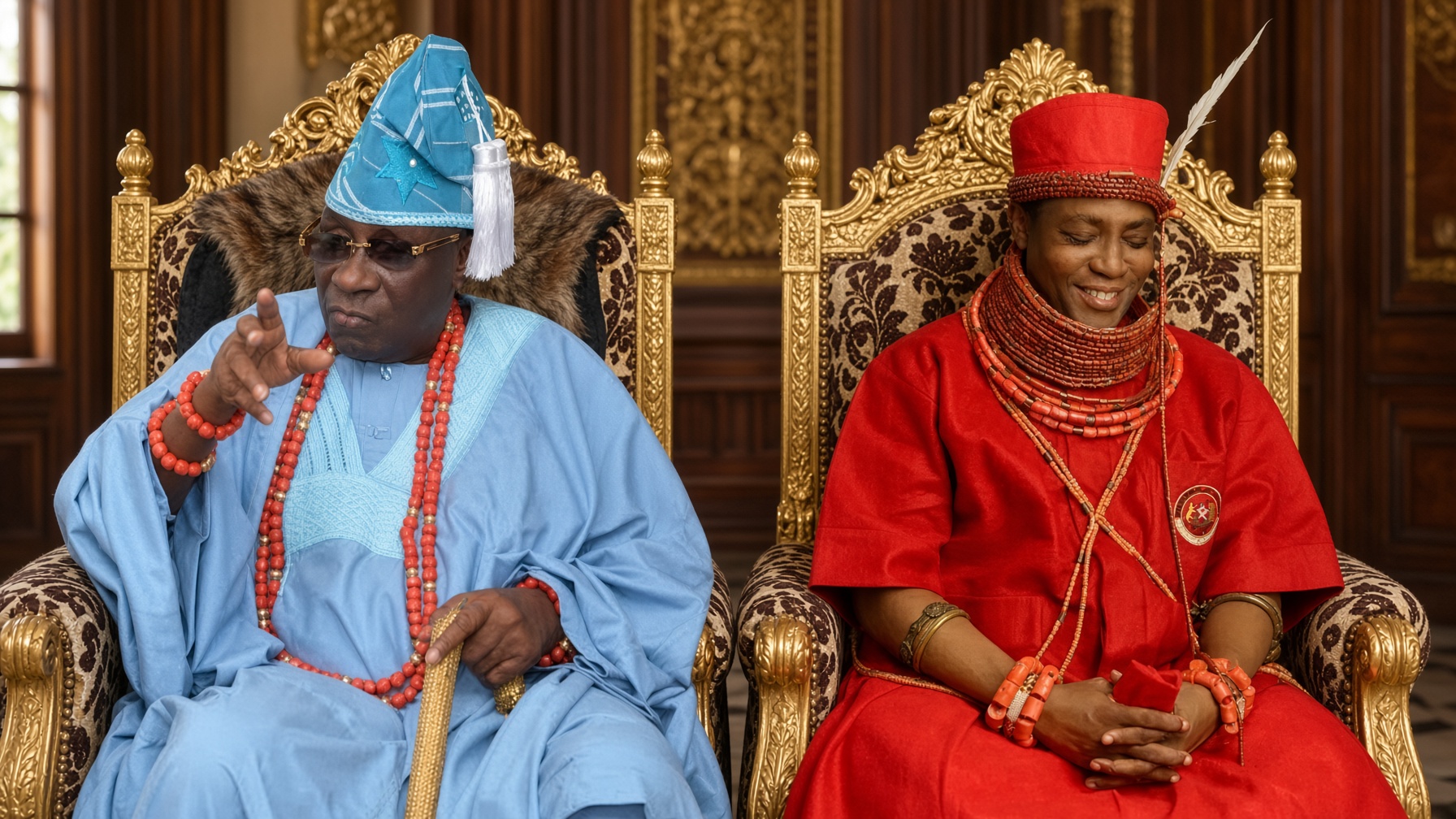
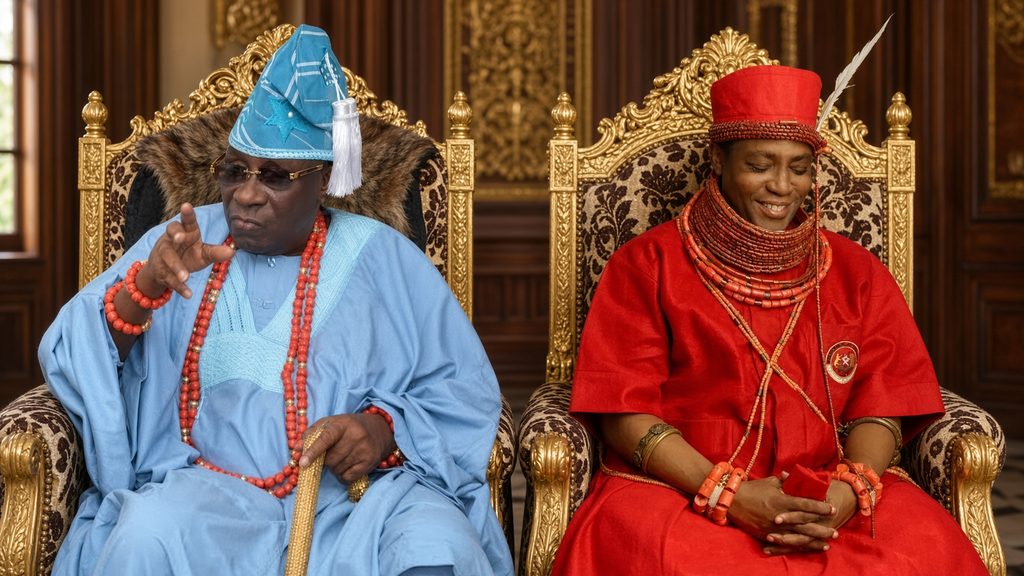
Two of Nigeria’s most prominent traditional rulers have stepped into the 2027 presidential contest after receiving the All Progressives Congress campaign council, triggering a row over whether kings should stay above party politics.
On Monday, Oba Rilwan Akiolu of Lagos told the APC Presidential Campaign Council, led by its director-general, Senator Abdulaziz Yari, and accompanied by Governor Babajide Sanwo-Olu, that “for the next four or five years, there is no vacancy in Aso Rock.” The phrase, already a slogan among supporters of President Bola Tinubu, was delivered as an open vote of confidence in a second term.
Akiolu also called for a peaceful election, warned politicians against the idea that “the end justifies the means,” and revived Lagos’s long-standing demand for special constitutional status. He recalled that the Lagos government approved his nomination as Oba in May 2003, when Tinubu was governor a personal link that needed little explanation in the palace.
On Tuesday the same campaign team was in Benin City. Oba Ewuare II received Yari and said the Benin throne “is not partisan.” In the next breath he asked why anyone would change a government “just for the sake of changing.” Some reports have him going further, saying a leader who is “doing well” should be allowed to finish the work and that Tinubu should receive a renewed mandate. He also argued that opposition parties need not treat the government as an enemy.
The contradiction is the political story. One palace announced there was no vacancy. The other announced it was not political, then offered a continuity argument that only one candidate can use.
Former vice-president Atiku Abubakar, now the African Democratic Congress presidential candidate, replied that Aso Rock “is not an extension of your palace” and that Nigeria’s presidency “is not a royal stool for you to allocate.” There will be a vacancy in 2027, he said, because the constitution requires an election. A monarch may prefer a candidate; he cannot prefer one on behalf of more than 200 million people.
That is the legal position. The political position is more tangled.
A campaign that starts in the palaces
Yari’s itinerary has been a royal circuit: the Sultan of Sokoto, the Oba of Lagos, the Oba of Benin, the Shehu of Borno. The official language is always the same blessings, prayers, advice. The political purpose is not. In much of Nigeria a first-class stool still confers a kind of moral cover. An endorsement is not a bloc vote, but it is a signal to local elites, market associations, religious networks and rural voters that the candidate has been received as legitimate.
It is also cheap insurance. Traditional rulers do not appear on the ballot. They cannot be defeated at a primary. When they speak, the party gets the photograph and the headline; when the election turns ugly, the palace can retreat behind custom.
What these stools used to be and what they are now
Before colonial rule, an Oba or emir was a sovereign in a limited sense: war, tribute, land, customary justice and the ritual life of a people sat in one person. The British did not abolish that authority. They rented it. Indirect rule made chiefs the cheap administrative layer of empire tax collectors and native-court presidents who answered upward to a resident and downward to their own subjects.
Independence did not restore sovereignty. The 1963 constitution still gave the Oba of Lagos an ex-officio Senate seat. The 1976 local-government reforms and the military constitutions that followed stripped traditional rulers of executive power. The 1979 and 1999 constitutions barely mention them. Section 7 of the 1999 constitution is careful to keep local government free of chieftaincy functions. Traditional rulers sit, at best, on advisory state councils of chiefs. They have no federal mandate.
And yet they have not withered. They remain the first port of call in communal conflict, land disputes, youth unrest and, increasingly, local security. Governors still queue at palaces before elections and still threaten stools after them. Creation, recognition, stipend, palace renovation, official cars and, in some states, the power to dethrone: these are the instruments of control. The Kano emirate crisis is only the most famous recent example of a throne becoming a prize in a gubernatorial feud.
That is the structural fact behind this week’s remarks. These men are not constitutional officers. They are culturally powerful, fiscally dependent and politically useful. Dependence is not neutrality.
There is a live attempt to change that. Bills before the National Assembly would create national and state councils of traditional rulers and write advisory roles custom, public order, security into the constitution. The proposal is popular among monarchs and some governors. It is also contested, not least because drafts have toyed with permanent co-chairs for particular stools. A constitutional role without political insulation would not end palace politics. It would nationalise it.
Why these statements, and why now?
Timing is not mysterious. Nigeria is more than a year from the presidential vote, but the campaign is already a machine. Early royal visits set a narrative of inevitability: the country is being blessed, not merely canvassed. “No vacancy” is designed to demoralise rivals and to tell fence-sitters that the matter is settled.
Personal history matters too. Akiolu’s stool was confirmed while Tinubu governed Lagos. The Oba of Benin had a publicly bitter relationship with former governor Godwin Obaseki; relations with the present APC administration in Edo have been warmer. Palaces remember who paid courtesy, who funded festivals, who intervened in chieftaincy disputes, and who did not.
There is also a quieter calculation. Traditional rulers have spent years arguing that they are indispensable to security and social order and therefore deserve formal recognition. Being useful to the incumbent is one way of keeping that argument alive. Being useful to the opposition is riskier when governors, not voters, still hold the warrant of the stool.
Akiolu is not new to this terrain. In 2015 he was widely reported as warning Igbo residents of Lagos that those who voted against his preferred governorship candidate would “perish in the lagoon.” He later said he had been misunderstood. The episode remains a reminder that royal speech in an election season is never only ceremonial.
Should they speak or stay silent?
There are two serious arguments, and they should be heard without piety.
The case for speaking is that neutrality is already a fiction. Traditional rulers live among the same scarcities as their people. They see insecurity, inflation and the decay of local order at closer range than most senators. If continuity or change is a public question, why should the one institution that still commands cross-party deference pretend to have no view? In Britain the Crown is silenced by convention and by a written set of expectations around a constitutional monarchy. Nigeria has neither a working convention nor a constitutional monarchy. It has stools that the state refuses to empower and refuses to leave alone. Asking them to be Swiss while governors treat them as campaign props is not principle. It is selective amnesia.
The case for restraint is stronger on democratic grounds. A first-class Oba is not a columnist. His words arrive with the weight of ancestry, ritual and, in many communities, fear of spiritual and social sanction. When he says there is no vacancy, he is not offering an opinion poll. He is implying that the contest itself is slightly improper. That sits badly with a constitution that vests sovereignty in the people and fixes a four-year term. It also splits the palace’s own constituency. Lagos is not a Yoruba village. Benin City is not a court of unanimous subjects. An endorsement that pleases the resident governor can alienate traders, tenants, migrants and younger voters who do not regard the throne as their returning officer.
There is a further cost. Every partisan intervention makes the next dethronement easier to justify. If the stool is a campaign asset, the next governor will treat it as one. The Sanusi–Bayero saga in Kano showed how quickly “custom” becomes a weapon once politicians decide the palace has picked a side.
A cleaner rule would be modest and enforceable. Traditional rulers may receive all candidates. They may preach peace, voter registration and a violence-free poll which the Independent National Electoral Commission itself has asked them to do. They may even, in private, advise. What they should not do is declare the presidency closed, or dress a party slogan as ancestral wisdom, while claiming the throne is above politics. That is not culture. It is a press statement in beads.
Ewuare II almost found the right sentence: the Benin throne is not partisan. The rest of the audience needed him to stop there. Akiolu did not even start there. Both men are entitled to their view of Tinubu. Neither is entitled to rent the mystique of the stool to a campaign council and then retreat behind custom when the opposition answers back.
Nigeria’s monarchs survived empire, the First Republic, the soldiers and the Fourth Republic because they could still present themselves as a residual public older than the parties, thicker than the constitution. That claim is only as strong as their distance from the men who sign their warrants. The closer the 2027 campaign draws, the more that distance is being spent.
By A.Ikechukwu
- No vacancy in Aso Rock: Lagos and Benin monarchs stir 2027 storm
- Which reparations? As Africa leads a global slavery claim, critics say stolen wealth at home must come first
- US lobbyist files $26m defamation suit against Sahara Reporters in Washington
- Ekweremadu still in British jail as late 2028 release date looks more realistic than mid-2027 claims
- The Madness of a Mantra: Nigeria Has Spent Nearly 50 Years Blaming Leadership While Ethnicity Manufactures the Leaders It Gets