Nigeria, a country of over 200 million people and more than 250 ethnic groups, has long struggled with the tension between the ideal of national unity and the reality of deep-seated ethnic particularism. The slogan “One Nigeria” is routinely invoked by political leaders, especially from the North, as a rallying cry against secessionist agitation or regional discontent. Yet, a closer examination of the institutional landscape in Northern Nigeria reveals a stark contradiction: while publicly preaching unity, the region has consistently nurtured powerful ethnic and regional organisations whose very existence and activities reinforce the idea that the North is a distinct political entity, separate from – and often in opposition to – the rest of the country.
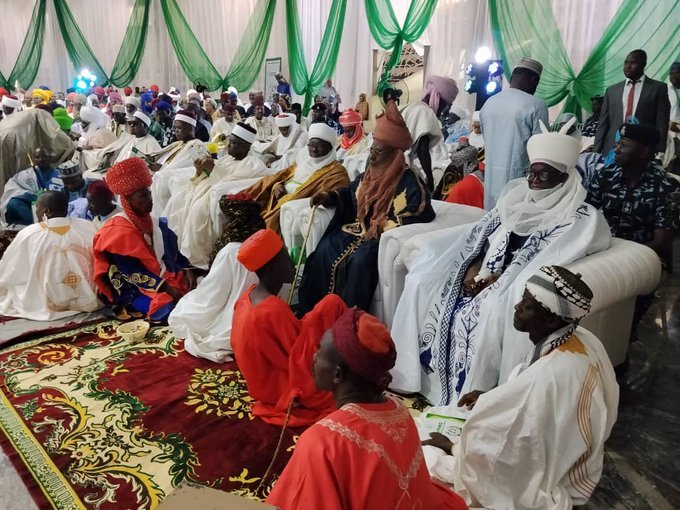
Established in 2000, the Arewa Consultative Forum (ACF) presents itself as a socio-cultural and political platform for the “Northern region.” Its membership is almost exclusively drawn from the nineteen northern states, and its leadership has historically been dominated by Hausa-Fulani elites. The ACF has intervened repeatedly in national debates with a clearly regional slant: opposing restructuring proposals that would reduce the North’s perceived advantages under the current federal arrangement, resisting the rotation of the presidency away from the North when it suited its interests, and issuing statements that frame southern political demands as attacks on “Northern interests.”
Far from being a neutral think-tank, the ACF functions as an ethnic lobby that counters any narrative suggesting Nigeria is – or should be – a truly unified nation. Whenever zoning arrangements are questioned, resource control debated, or insecurity in the South-East or South-West threatens to shift national attention, the ACF is quick to remind Nigerians that the North must be “protected” as a bloc. In doing so, it perpetuates the idea that the primary loyalty of Northern politicians and traditional rulers is not to Nigeria as a whole, but to an imagined “Arewa” – a Hausa word meaning “Northerners.”
This pattern is not new. In the First Republic, the dominant political party in the North was the Northern People’s Congress (NPC), whose name alone announced its regional and ethnic character. Founded in 1949 as the cultural organisation Jam’iyyar Mutanen Arewa, it transformed into a political party whose slogan – “One North, One People” – deliberately excluded the Middle Belt and non-Hausa-Fulani minorities even within the Northern Region itself. The NPC’s leadership, under Sir Ahmadu Bello, the Sardauna of Sokoto, openly pursued a “Northernisation” policy that privileged Northerners in civil service appointments and economic opportunities, even when qualified Southerners were available.
The NPC never pretended to be a national party; its alliance with the National Council of Nigerian Citizens (NCNC) was one of convenience, not ideological unity. The very existence of a party named the Northern People’s Congress sent an unambiguous message: the North saw itself as a political entity distinct from – and determined to dominate – the rest of Nigeria. That legacy of regional political organisation has never been abandoned; it has merely been rebranded.
The ACF is only the most prominent of a constellation of exclusively Northern organisations that institutionalise ethnic separatism while paying lip service to national unity:
The Northern Elders Forum (NEF), another influential body of retired generals, emirs, and politicians, routinely issues statements that frame national issues almost entirely through the prism of “Northern interest.”
The Arewa Youth Consultative Forum and similar youth wings mobilise young Northerners along regional lines.
The Sir Ahmadu Bello Memorial Foundation and the Arewa House in Kaduna serve as intellectual and cultural centres dedicated to celebrating Northern exceptionalism.
Even ostensibly religious bodies such as the Jama’atu Nasril Islam (JNI) and the Supreme Council for Islamic Affairs often function as Northern political pressure groups in practice.
These organisations do not include Southerners in their leadership or membership in any meaningful way. They do not pretend to speak for Nigeria as a whole. Their conferences, communiqués, and interventions almost invariably begin with the phrase “The North…” rather than “We Nigerians…”
The hypocrisy reaches its peak when these same Northern organisations accuse Southern groups – such as Ohanaeze Ndigbo, Afenifere, or the Pan-Niger Delta Forum – of “promoting ethnic agenda” or “threatening national unity.” The double standard is breathtaking. When Igbo leaders meet in Enugu to discuss marginalisation, they are labelled tribalists. When Yoruba elders gather in Ibadan to demand restructuring, they are accused of heating up the polity. Yet when Northern emirs, governors, and elders convene under the ACF or NEF banner to oppose devolution of power or defend the status quo, it is presented as “defending the indivisibility of Nigeria.”
This selective outrage reveals the true objective: not unity, but the preservation of a political arrangement that has allowed the North to dominate national institutions disproportionately since independence.
Nigeria will never become a truly unified nation as long as powerful regional blocs continue to organise politically along ethnic lines while simultaneously claiming the mantle of national patriotism. The existence of the Arewa Consultative Forum, the Northern Elders Forum, and their predecessors such as the NPC is not merely a cultural curiosity – it is a structural obstacle to nation-building. These bodies do not complement national unity; they undermine it by constantly reinforcing the idea that the primary political identity of a Northerner is “Arewa,” not “Nigerian.”
If Northern leaders genuinely believe in “One Nigeria,” the logical first step would be to dissolve or radically transform these exclusively Northern platforms and create truly national organisations that include Southerners as equal partners from the outset. Until that happens, the phrase “One Nigeria” will continue to ring hollow coming from the very mouths that have spent decades building and sustaining the institutional architecture of “Northern Nigeria.”
The country deserves better than a unity that is preached in public and systematically sabotaged in practice.