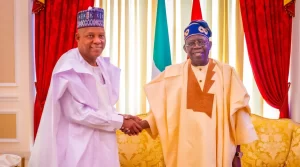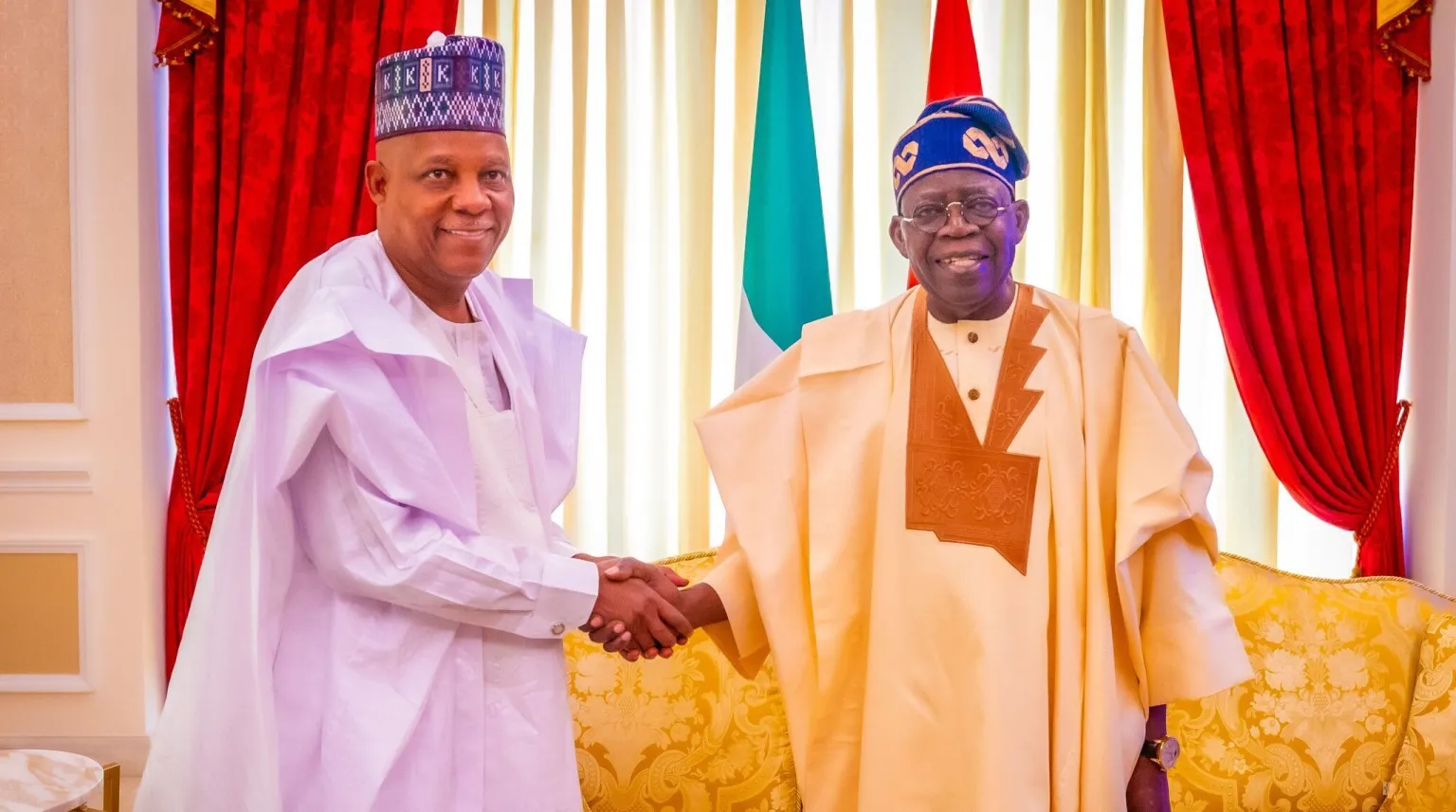
ABUJA / LONDON — President Bola Tinubu is in Paris on the second leg of a three-week working leave that began in London, while Vice-President Kashim Shettima is in New Delhi representing Nigeria at the 18th BRICS Leaders’ Summit. The overlapping absences have revived a familiar constitutional argument: whether the President is obliged to hand over formally to his deputy whenever he leaves the country — and whether the law enacted after the Yar’Adua–Jonathan crisis is being observed.
The Presidency has described the trip as annual leave. Tinubu left Abuja on 30 August, spent the first fortnight in the United Kingdom, and arrived in Paris on Sunday 13 September. He is expected back next weekend. Shettima, leading a ministerial delegation, is standing in for him at the Indian summit under the theme “Building Resilience, Innovation, Cooperation and Sustainability.” Nigeria attends as a BRICS partner country.
This is not an isolated arrangement. Since 2023 Shettima has frequently taken Tinubu’s place at high-level gatherings, including successive United Nations General Assembly sessions. What has not happened, according to public records, is a formal transmission of presidential functions under Section 145 of the 1999 Constitution. There is no publicly documented instance of Tinubu writing to the Senate President and the Speaker to make Shettima Acting President.
That gap is the legal issue.
What the constitution says
Section 145, as substituted by the Constitution (First Alteration) Act 2010, is the provision written after the late President Umaru Musa Yar’Adua left for medical treatment in Saudi Arabia in November 2009 without notifying the National Assembly. For months the country had no formally designated acting head of state. In February 2010 the Senate invoked the extra-constitutional “doctrine of necessity” to make Goodluck Jonathan Acting President. The 2010 amendment was designed to stop that vacuum recurring.
The operative text now reads, in substance:
- Whenever the President is proceeding on vacation or is otherwise unable to discharge the functions of his office, he shall transmit a written declaration to the President of the Senate and the Speaker of the House of Representatives. Until he transmits a contrary declaration, the Vice-President shall perform those functions as Acting President.
- If the President is unable or fails to transmit that declaration within 21 days, the National Assembly shall, by a simple majority in each House, mandate the Vice-President to act as Acting President until the President writes that he is available to resume.
Two points follow immediately.
First, the trigger is not “being outside Nigeria.” It is vacation, or inability to discharge the functions of the office. Mere official travel does not, by itself, create an acting presidency. Several other African constitutions treat physical absence from the country as the trigger; Nigeria’s text does not.
Second, physical absence of both the President and the Vice-President does not hand power to Senate President Godswill Akpabio. Section 146 applies only when the office of President is vacant, death, resignation, impeachment, permanent incapacity or removal. Simultaneous foreign travel is not a vacancy. Executive power under Section 5 may still be exercised by the President, or through ministers and other officers of the Federation.
Where the argument splits
Lawyers disagree on what “shall” in Section 145(1) requires once a trip is labelled a vacation.
One school reads the clause literally. “Shall” is obligatory. The moment the President proceeds on vacation he must write to the National Assembly. Subsection (2) is a remedy for default, not a 21-day licence to ignore subsection (1). On that reading, a three-week “working vacation” in London and Paris, announced as annual leave, engages Section 145(1) from the day of departure. The Presidency’s silence on whether any letter was sent is, on this view, the problem.
The competing school — closer to the position successive presidencies have taken is that the President remains capable of discharging his functions remotely, that a working leave is not the same as incapacity, and that subsection (2) only arms the National Assembly after 21 days. Previous Tinubu absences of 10 days and a fortnight ended before that clock ran out; the Assembly never passed a resolution making Shettima Acting President. The current leave was advertised as three weeks 21 days which puts the return date at the edge of the statutory window.
Muhammadu Buhari’s first-term practice is the usual contrast. He several times transmitted letters so that Yemi Osinbajo became Acting President during medical treatment and holidays. He later argued, including on affidavit, that handover was required only when leave exceeded 21 days. That claim is not written into the text. Subsection (1) does not say “if the vacation exceeds 21 days.” The 21 days appear only in subsection (2), as the point at which the legislature must step in if the President has failed to write.
The legal case, stripped of politics
A court asked to decide the present facts would have to answer four questions:
- Is a “three-week working vacation / annual leave” in Europe a “vacation” within Section 145(1)? If the Presidency’s own language is taken at face value, yes.
- Does “shall transmit” impose an immediate duty, or only a duty that becomes enforceable after 21 days? The ordinary meaning of “shall,” and the history of the 2010 amendment, favour an immediate duty. Subsection (2) is the sanction for failure, not a waiting period that suspends the duty.
- Has a written declaration in fact been sent? As of early September, presidential and National Assembly officials would not confirm that it had. Absence of a public announcement is not conclusive proof that no letter exists, but it is the evidence available.
- Even without a formal acting presidency, is there an unconstitutional vacuum? Not automatically. The President is not stripped of office by crossing a border. Ministers remain in post. What is missing is the clear, temporary transfer of full presidential functions that Section 145 was written to provide the very transfer the 2010 alteration was meant to make routine after Yar’Adua.
The stronger legal complaint is therefore not that “Nigeria has no president” while Tinubu is in Paris and Shettima is in Delhi. It is that a President who has announced a vacation has not, so far as the public record shows, done the one thing the post-Yar’Adua constitution requires him to do: tell the National Assembly in writing, so that the Vice-President may act as Acting President until he writes again that he is ready to resume.
That is a narrower case than the political charge that the President “must hand over whenever he stays abroad.” The constitution does not say that. It does say that when he proceeds on vacation he shall transmit a declaration. The First Alteration Act was passed because a president once declined to do so, and the country had to invent a doctrine of necessity to keep the state functioning. Sixteen years later, the letter is still the mechanism. Whether it has been sent this time is a question the Presidency can answer in a sentence.
By A. Ikechukwu- Law Journalist
- Tinubu in Paris, Shettima in Delhi: what Nigeria’s constitution actually requires when both leaders are abroad
- The 2003 FBI letter, the Chicago files, and what Reno Omokri’s “clean bill” claim actually proves
- After London acquittal, Diezani Alison-Madueke faces a second legal battlefield in Nigeria
- Tinubu arrives in Paris for the second leg of his foreign holiday.
- Prince Eka William, Cross River power commissioner, dies suddenly in Abuja hospital